MANAGEMENT SYSTEM DESIGN
Connecting direction, development and daily work.
We help organizations design and improve integrated management systems that connect strategic priorities with value stream performance, development activities and everyday team management.
By aligning objectives, decision-making, management practices and continuous improvement across organizational levels, we help turn strategic direction into coordinated action and measurable performance.

THE CHALLENGE
When management practices don't form a system.
Organizations often have strategies, objectives, performance measures, management meetings and development initiatives. Yet these elements do not necessarily work together.
Strategic priorities may remain disconnected from daily decisions. Development initiatives compete for limited resources, while operational problems and improvement opportunities do not consistently translate into coordinated action.
The challenge is often not a lack of management practices, but a lack of connections between them.
Strategy disconnected from everyday management
Strategic priorities are defined, but their connection to operational objectives, development activities and daily decisions remains unclear.
Competing development priorities
Improvement ideas and initiatives emerge throughout the organization, but there is no consistent way to evaluate, prioritize and allocate resources to them.
Fragmented management and decision-making
Meetings, performance measures and management routines exist, but information, responsibilities and decision-making are not sufficiently connected across organizational levels.
OUR APPROACH
Three perspectives. One connected management system.
An effective management system connects strategic leadership, value stream performance and everyday team management. Each perspective has a distinct purpose, but none should operate in isolation.
We use these perspectives to understand how an organization is managed, identify gaps and design practices that fit its needs. They provide a framework for thinking, not a fixed organizational structure or prescribed management model.
STRATEGIC LEVEL
Direction, priorities & development portfolio
Strategic management connects the organization's strategic choices with development priorities, resource allocation and long-term performance. It provides a systematic way to manage the development roadmap, evaluate initiatives and maintain focus as circumstances change.
VALUE STREAM LEVEL
End-to-end performance & coordinated development
Value stream management connects strategic priorities with the activities through which customer value is created. Shared objectives, performance measures and development priorities help coordinate work across organizational boundaries and improve the performance of the whole.
TEAM LEVEL
Daily performance, problem solving & improvement
Team-level management connects objectives with everyday work. Clear priorities, visible performance and practical problem-solving routines enable teams to manage their operations, respond to deviations and improve how work is done.
MAIN MANAGEMENT SYSTEM ARCHITECTURE
Connecting strategic direction, value stream performance and daily team management
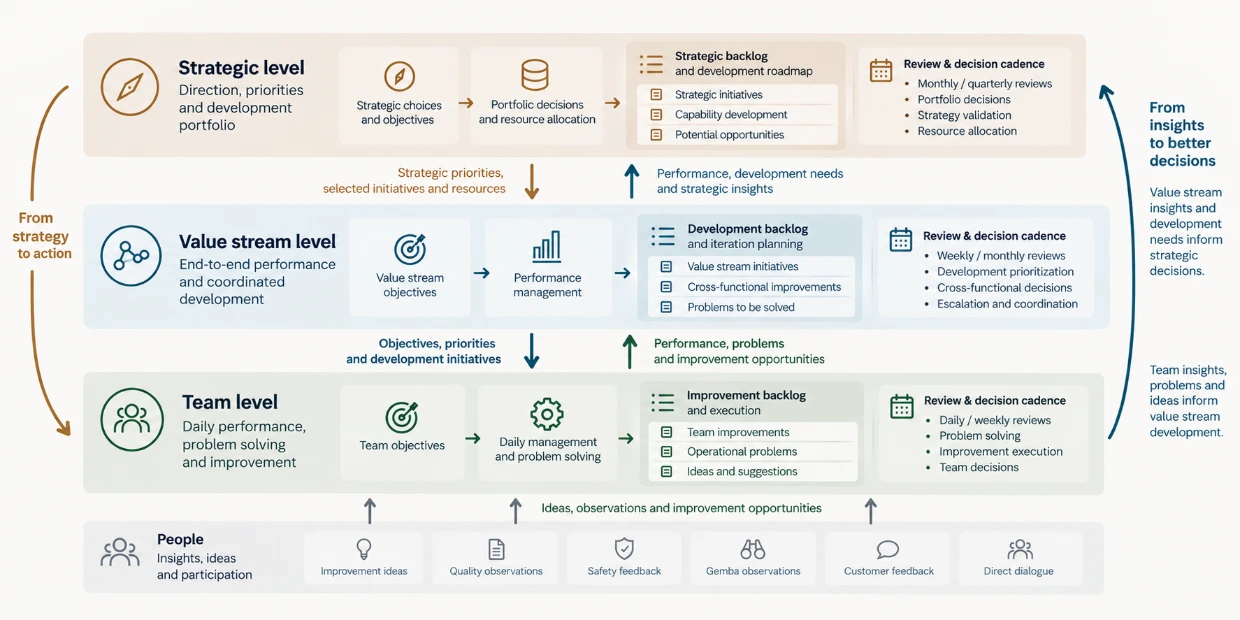
An illustrative management architecture. The practices, structures and connections are adapted to each organization's needs. The value of this type of architecture lies not only in the management practices at each level, but in how they connect. Strategic direction guides development and daily work, while operational insights and improvement needs inform decisions throughout the system.
THROUGHOUT THE SYSTEM
The real value lies in the connections.
A management system becomes effective when direction, information, decisions and learning flow across organizational levels.
Strategic priorities guide action, while operational insights inform development and strategic decisions. The system must connect different management rhythms, enable decisions at the appropriate level and ensure that improvement efforts support the organization's overall direction.
Direction and learning flow both ways
Strategic priorities are translated into objectives and actions across the organization, while operational insights, new opportunities and emerging risks inform decisions at higher levels.
Dialogue helps refine direction and build commitment rather than simply communicating decisions already made.
Decisions are made at the right level
Effective management requires clarity about decision rights, responsibilities and escalation.
Teams should resolve issues within their authority, cross-functional challenges should be addressed together, and strategically significant decisions should reach leadership with the information needed to act.
Performance and development are managed together
Managing current performance and improving future performance are two parts of the same system.
Operational deviations, recurring problems and improvement opportunities inform development priorities. In turn, development initiatives are evaluated through their contribution to operational performance and longer-term business objectives.
Different rhythms support one direction
Strategic reviews, development planning and daily management operate on different time horizons.
Their rhythms must be connected so that information reaches decision-makers when needed, progress is reviewed systematically and the organization can adapt without constantly changing priorities.
Everyone contributes to improvement
A management system should make it easy for people to raise concerns, share ideas and contribute their expertise.
Quality observations, safety feedback, improvement suggestions and direct dialogue provide valuable insights. Clear mechanisms ensure these inputs lead to appropriate action rather than disappearing into disconnected reporting channels.
Focus requires deciding what not to do
Ideas and improvement needs emerge throughout the organization, but resources are always limited.
Effective management means making deliberate choices about what to pursue, postpone, stop or leave undone. Connected development backlogs, clear priorities and transparent resource decisions help limit work in progress and ensure that the most important initiatives move forward.
IN PRACTICE — CONNECTING MANAGEMENT ACROSS LEVELS
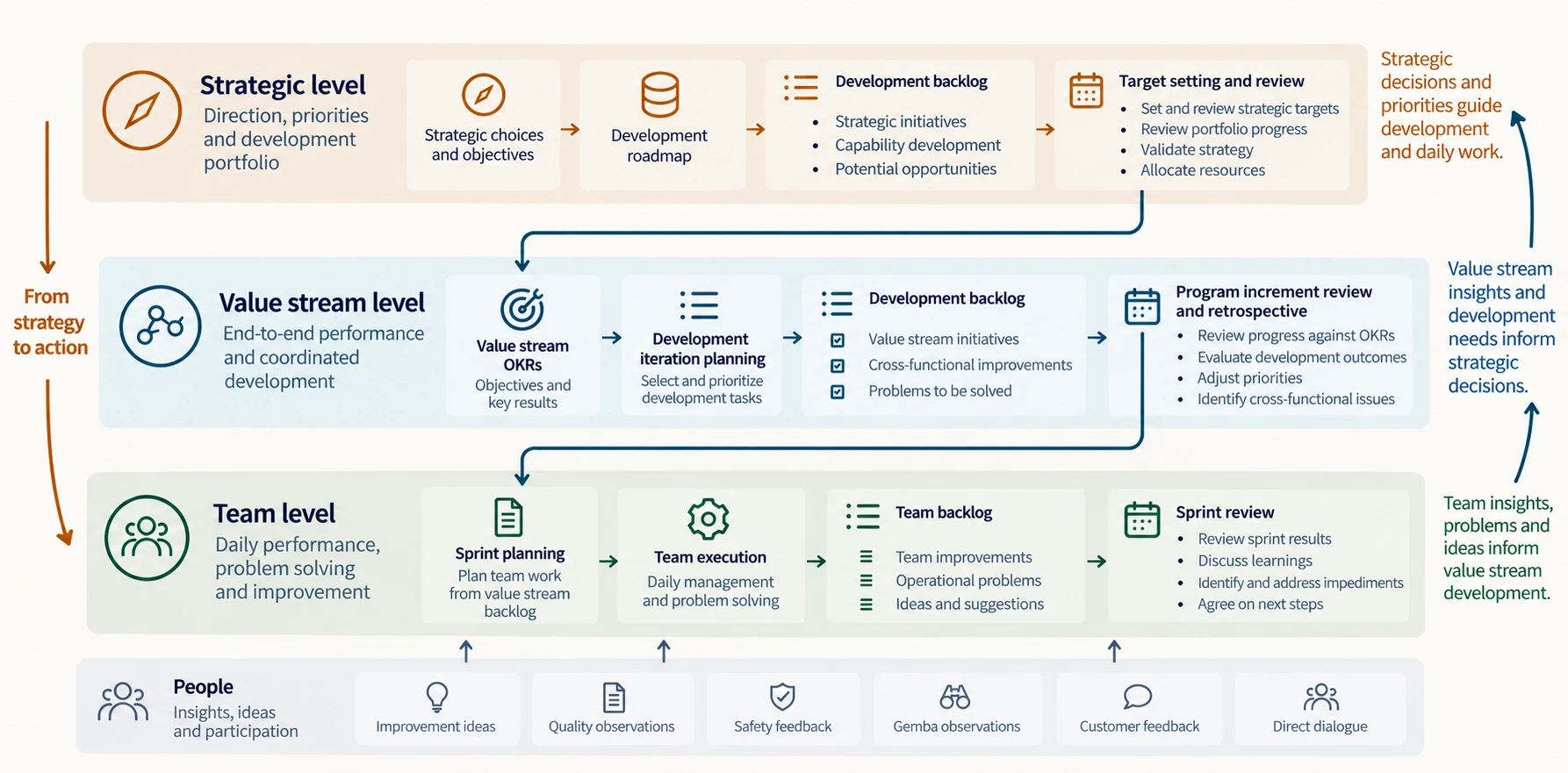
A real-world implementation connecting strategic priorities with team-level execution.
At the strategic level, a development backlog helped manage competing initiatives and limit work in progress. By focusing resources on fewer priorities at a time, the organization reduced workload and ultimately completed more development initiatives.
Strategic development objectives provided the basis for value stream OKRs. Development backlogs and iteration planning at the value stream level guided team-level sprint planning and execution. Reviews and retrospectives connected operational learning with broader development decisions.
The example demonstrates how management practices at different levels can be deliberately connected, creating a structured flow from strategic direction to practical improvement and back.
Designed for the organization, not the other way around.
There is no single management system that fits every organization.
The right solution depends on the business, its complexity, culture and existing capabilities. We build on what already works, improve what is missing and develop the system step by step, without introducing unnecessary structures or bureaucracy.
WHAT WE WORK ON
Management system development tailored to your needs.
An effective management system does not require a complete organizational transformation.
We can help design the overall management system or improve selected elements, always considering how they fit into the broader management system.
Management system architecture & alignment
Designing the connections between strategic leadership, value stream management and team-level practices, including responsibilities, decision-making and management structures.
Strategic management & development portfolio
Connecting strategic priorities with development roadmaps, development backlogs, initiative selection, resource allocation and systematic follow-up.
Value stream & performance management
Establishing shared objectives, performance measures and development practices that improve end-to-end performance across organizational boundaries.
Management cadence & decision-making
Designing management rhythms, review practices, escalation mechanisms and decision-making responsibilities that connect organizational levels.
Daily management & systematic problem solving
Developing practical management routines, visual performance management, problem-solving practices and continuous improvement capabilities.
OUR PERSPECTIVE
“Great management is not about controlling every action. It is about creating the conditions for people to succeed together.”
WHAT YOU GAIN
Clearer priorities. Better decisions. Stronger execution.
An integrated management system helps organizations direct their resources towards the right priorities, respond to challenges more effectively and build continuous improvement into everyday management.
Clear direction and alignment
Strategic priorities guide objectives, development and decision-making throughout the organization.
Better use of resources
Development initiatives are prioritized systematically, reducing competing demands and unnecessary work.
Faster and more effective decisions
Clear responsibilities, management routines and escalation paths help organizations address issues at the appropriate level.
Continuous organizational learning
Operational insights, improvement activities and emerging opportunities inform decisions across management levels and strengthen the organization's ability to adapt.
START A DIALOGUE
Ready to make management work as one system?
Whether you're connecting strategy with everyday management, improving development governance or strengthening operational leadership, let's explore how Adopex can help.